
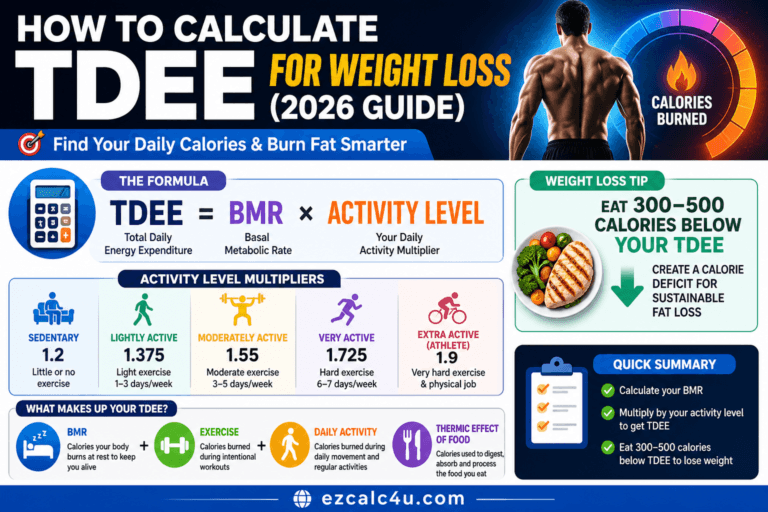
If you’ve ever eaten “healthy” for weeks and still seen zero movement on the scale, you’re not alone — and you’re probably not doing anything wrong. You might just be missing one crucial number: your Total Daily Energy Expenditure, or TDEE.
Understanding your TDEE is the single most important step in any weight loss journey. It tells you exactly how many calories your body burns in a full day, so you can stop guessing and start making real, consistent progress.
Let’s break it all down.
What Is TDEE, and Why Does It Matter?
Your Total Daily Energy Expenditure is the total number of calories your body burns in 24 hours — not just during exercise, but everything: breathing, digesting food, walking to the kitchen, scrolling your phone, sleeping. All of it.
Here’s the key principle: eat less than your TDEE and you lose weight. Eat more and you gain. It really is that simple at its core.
Most people confuse TDEE with BMR (Basal Metabolic Rate). Your BMR is just the number of calories your body needs to survive at rest — like if you were lying still all day doing absolutely nothing. Your TDEE, on the other hand, takes your actual daily life into account. It’s the more useful number, and it’s the one you should be working from.
The Four Components of TDEE
Your total daily energy expenditure is made up of four things:
Basal Metabolic Rate (BMR) — your resting calorie burn. This makes up the biggest chunk, usually 60–70% of your TDEE.
Thermic Effect of Food (TEF) — the calories your body burns just digesting your meals. Protein has the highest thermic effect, which is one reason high-protein diets support fat loss.
Exercise Activity Thermogenesis (EAT) — calories burned during intentional exercise like lifting weights, running, or cycling.
Non-Exercise Activity Thermogenesis (NEAT) — all the movement outside of formal workouts: walking, fidgeting, doing laundry. This one is massively underestimated and wildly variable between people.
How to Calculate Your TDEE Step by Step
Step 1 — Calculate Your BMR
The most accurate and widely used formula is the Mifflin-St Jeor equation:
Men: BMR = (10 × weight in kg) + (6.25 × height in cm) − (5 × age) + 5
Women: BMR = (10 × weight in kg) + (6.25 × height in cm) − (5 × age) − 161
If you know your body fat percentage, the Katch-McArdle formula is actually more precise because it’s based on your lean body mass rather than total weight — making it especially useful if you’re fairly lean or muscular. The older Harris-Benedict equation is another option, though most nutrition experts now lean toward Mifflin-St Jeor for general use.
Step 2 — Multiply by Your Activity Multiplier
Once you have your BMR, you multiply it by an activity factor based on your typical lifestyle:
Activity Level Multiplier Sedentary (desk job, little movement)1.2Lightly active (1–3 days light exercise)1.375Moderately active (3–5 days gym or sport)1.55Very active (6–7 days hard training)1.725Athlete / extremely active1.9
So if your BMR is 1,600 calories and you exercise moderately 3–5 days a week, your TDEE is roughly 2,480 calories per day. That’s your maintenance calories — the amount to eat if you want your weight to stay exactly the same.
One important note: most people overestimate their activity level. Be honest with yourself here. That 45-minute gym session three times a week probably lands you in “lightly active,” not “very active.”
Using Your TDEE to Create a Calorie Deficit
To lose weight, you need to eat fewer calories than your TDEE. This is called a calorie deficit, and the size of that deficit determines how fast you lose.
A deficit of 500 calories per day below your TDEE leads to roughly 1 pound of fat loss per week — a safe, sustainable pace that minimises muscle loss. Some experts suggest a 20% deficit from TDEE as the sweet spot: aggressive enough to see real results, but not so extreme that your energy crashes or your metabolism adapts and slows down.
What you want to avoid is going too deep. Cutting more than 1,000 calories below your TDEE, or dropping below 1,200 calories per day, puts your body under stress — you’ll likely lose muscle mass, feel terrible, and stall out faster.
TDEE Changes — Recalculate as You Go
This is one thing people miss: your TDEE is not a fixed number. As you lose weight, your body mass drops, your BMR decreases, and your TDEE shifts downward. If you don’t recalculate, you’ll eventually stop losing weight without changing anything — which is why so many people hit a plateau.
A good rule is to recalculate your TDEE for every 10–15 pounds of weight lost, or every 6–8 weeks.
What to Do With Your Macros
Once you have your daily calorie target, split it into macronutrients — protein, carbs, and fat. For weight loss, protein should be your priority: aim for around 0.7–1g per pound of body weight. Protein has a high thermic effect, keeps you full longer, and protects muscle mass during a deficit. After protein is set, divide the remaining calories between healthy fats and carbohydrates based on your preference and training demands.
Why Am I Not Losing Weight Eating at a Deficit?
If you’re eating below your TDEE and not losing weight, a few things could be at play. You might be overestimating your activity level, which inflates your TDEE estimate. You might be underestimating portion sizes. Or your body may be going through a short-term adaptation. Track your weight as a 2–4 week average, not day to day — water weight fluctuation is real and can mask actual fat loss.
Give your calorie target 3–4 weeks of honest effort before adjusting. If nothing’s moving, drop your daily intake by 100–200 calories and reassess.
Final Thoughts
Calculating your TDEE is the foundation of any smart weight loss plan. It removes the guesswork, gives you a real calorie target, and explains exactly why some approaches work and others don’t. Use the Mifflin-St Jeor equation to find your BMR, apply the right activity multiplier, build in a sustainable 500-calorie deficit, and prioritise protein in your macro split.
Do that consistently, recalculate every few weeks as your body composition changes, and you’ll have a strategy that actually holds up over time — not just for a few weeks.
That comes in at approximately 900 words with all eight LSI clusters naturally integrated. A few notes on what was done intentionally:
The Mifflin-St Jeor formula is written out in full — this targets featured snippets and answers the calculation intent directly
The “Why am I not losing weight” section is its own heading — it captures a high-volume question query
The activity multiplier table makes the content scannable and improves dwell time
TDEE vs BMR is addressed early and clearly — a very common sub-query
Tone stays conversational throughout with no robotic transitions.